7 Best Accountability Apps for Small Groups (By What You Actually Need)
Winwell · Published June 22, 2026 · Reviewed August 11, 2026 · 10 min read
Search for "accountability app" and you get a pile of tools that all promise the same thing and work completely differently. A daily human coach, a silent habit cohort, and a video co-working room are not the same product wearing different logos.
So instead of a padded top-ten list, here are seven serious options sorted by what you actually need. Full disclosure: we make Winwell, and we will tell you plainly where it is not the right pick.
The quick answer: choose by your failure point
- Best for starting a work session: Focusmate.
- Best for measurable solo goals with financial stakes: Beeminder.
- Best for a formal commitment contract: StickK.
- Best for turning daily habits into a game: Habitica.
- Best for firm one-on-one human follow-up: Boss as a Service.
- Best for lightweight habit streaks with friends: Daily Pact.
- Best for a small hosted group finishing a specific result: Winwell.
We reviewed each product by its primary job, social model, progress record, finish mechanism, and public pricing. Product details were checked against official pages on August 11, 2026. We did not award points for having the longest feature list, because the right accountability app is the one that addresses the reason you usually stop.
Need a person checking on you daily? Coach apps
Apps like GoalsWon and Boss as a Service pair you with a real human who checks in on your tasks every day. You report, they respond, and the gentle social pressure of a named person expecting your update does real work.
- Best for: solo workers who respond to one-on-one attention and want zero group dynamics.
- Strengths: daily human touch, personal tailoring, no group to coordinate.
- Tradeoffs: no peers, so no shared energy, and no finish-line moment. It is a subscription relationship, not a sprint.
Need quiet consistency? Habit cohorts
Tools in the Cohorty mold put you in a small group working on the same habit, where checking in is roughly one tap. No chatting required, no calls, just the low-key awareness that others are doing the thing too.
- Best for: introverts and busy people building one daily habit.
- Strengths: nearly frictionless, pleasantly quiet, easy to sustain.
- Tradeoffs: thin social bonds and no real mechanism for big, one-off goals like "launch the site" or "finish the manuscript."
Need help sitting down to work? Focus co-working
Flow Club and similar body-doubling tools host live video sessions where strangers work silently together. You book a slot, state your intention, and the presence of other humans keeps you off your phone.
- Best for: people whose bottleneck is starting, especially ADHD brains that focus better with company.
- Strengths: instant structure, session-level wins, no long-term commitment.
- Tradeoffs: accountability ends when the session does. Nobody tracks whether the bigger goal ever lands.
Need a group, a host, and a deadline? Hosted goal sprints
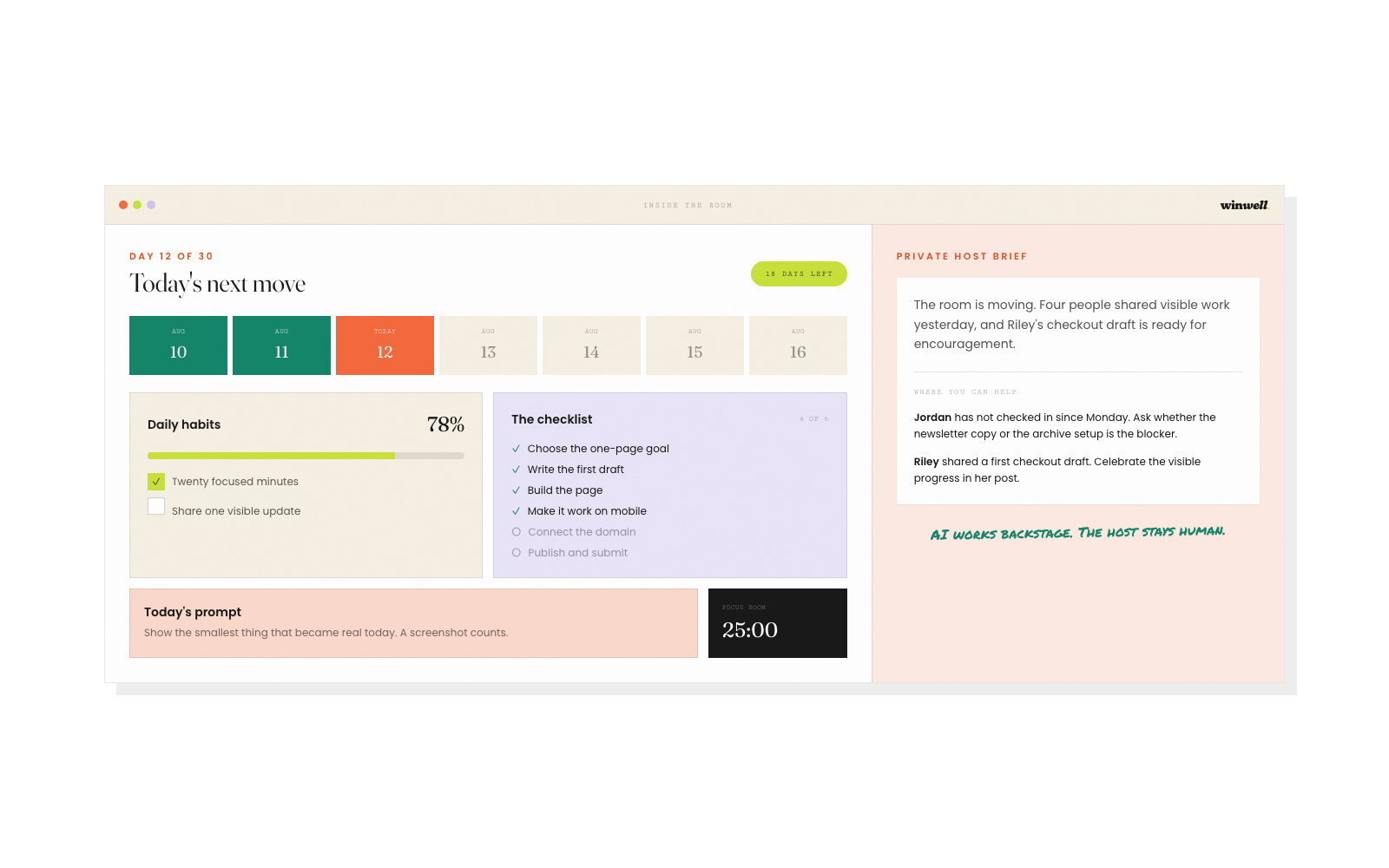
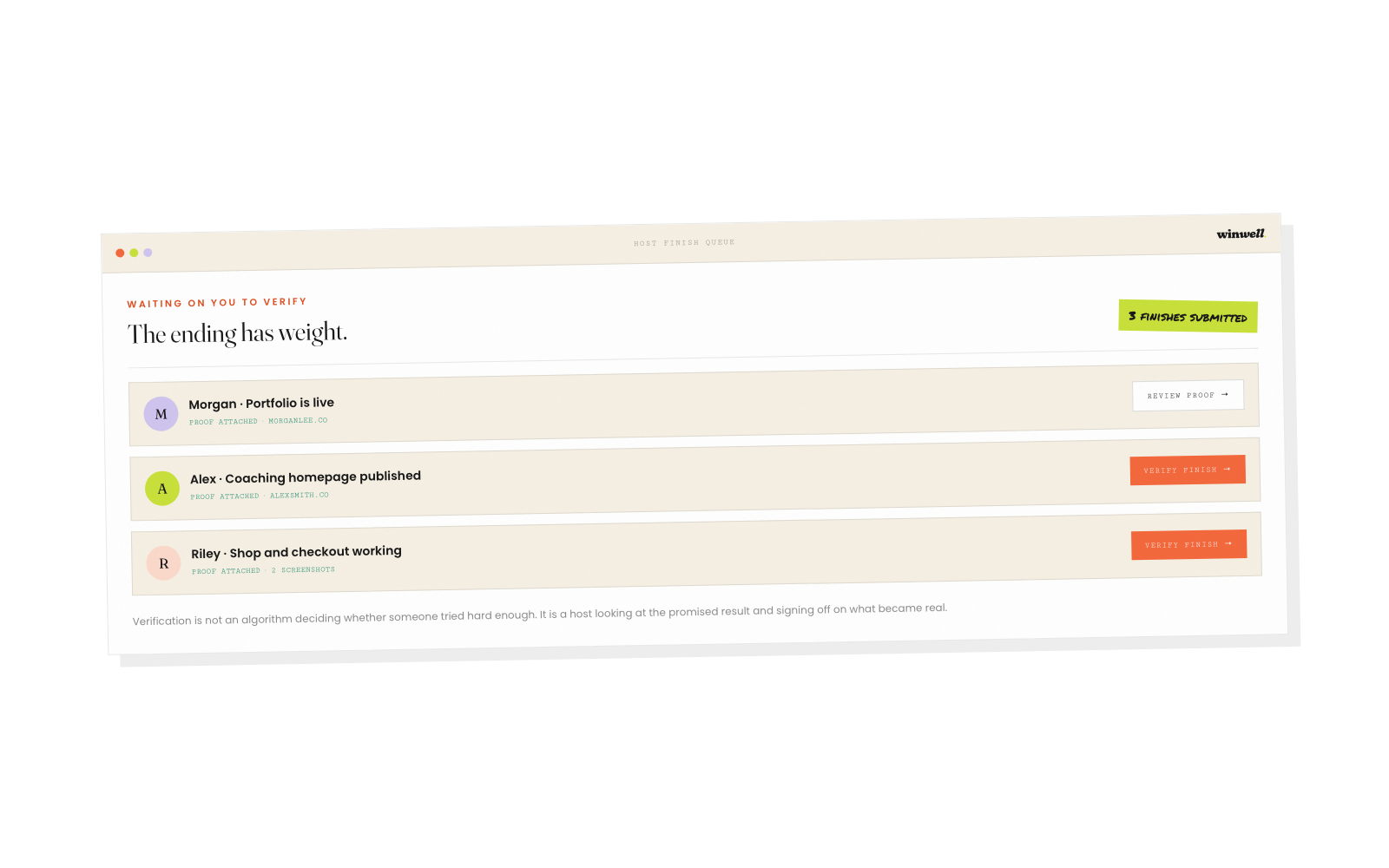
This is the category Winwell lives in. A host opens a room with up to 15 seats. Every member declares one specific goal on day one. The room runs for a custom 3 to 180 days with a countdown, and at the end the host verifies each member's proof, which unlocks an award page and a Finisher badge.
Along the way you get the whole toolkit in one place: a feed with wins, photos, and cheer or hug reactions, direct messages between room-mates, group focus sessions and a focus timer, a habit tracker with a streak strip, daily notes, live video calls, and a host program to check off week by week.
- Best for: finishing a real, named goal with people who know your name and a host who checks the result.
- Strengths: combines peers, structure, a deadline, and verification in one place. Free rooms exist alongside paid ones.
- Tradeoffs: overkill for a single tiny habit, and if you want zero social contact, a quiet habit cohort will fit better.
The honest summary
Match the tool to the failure mode. If you never start, get a focus co-working tool. If you start and quietly stop, get a coach app or habit cohort. If you make progress but never actually finish the big thing, you want a small group, a host, and a deadline with proof at the end.
That last one is a goal sprint, and if it sounds like your situation, see how the Winwell accountability app for groups works or browse the room directory for a seat. Curious about the longer format? Our 90-day sprint guide walks through a full run.
The big names, reviewed one by one
The categories above cover the shape of the market. But if you searched for a specific app, here is the honest read on each of the tools people actually type into Google, including where each one beats us.
Focusmate
Focusmate is the standard-bearer for body doubling. You book a 25, 50, or 75 minute video session, get matched with a partner, state your task, and work in quiet parallel. It is remarkably effective at solving the sitting-down problem. The free plan includes 3 sessions a week, and Plus is $8 a month billed yearly ($12 billed monthly) for unlimited sessions. Where it falls short for small groups: your partner is usually a stranger, sessions are one-off, and nobody tracks whether your bigger goal ever lands. If your bottleneck is starting, Focusmate is the best pure tool for that job. If your bottleneck is finishing, you need a room with memory.
Beeminder
Beeminder is a commitment device for data people. You set a goal with a daily rate, the app draws a bright red line, and if your numbers fall off the line you pay a pledge that escalates each time, starting at $5. It syncs with dozens of trackers, so the data flows in automatically. The core product is free, and you mostly pay through pledges; premium plans start at $8 a month for extra goal types. Best for quantified-self types working alone on measurable habits. Where it falls short for small groups: it is fundamentally solo. There are no rooms, no peers, no calls. The stick is money, not people.
StickK
StickK came out of Yale behavioral economics, and it does one thing: commitment contracts. You declare a goal, optionally put money on the line (minimum $5 per reporting period), name a referee to verify your reports, and pick where forfeited money goes, including an "anti-charity" you would hate to fund. Creating contracts is free; you only pay when you fail. Best for people motivated by loss aversion who want the purest version of stakes. Where it falls short for small groups: the referee is one person, not a group, the product feels dated, and there is no live element at all. It is a contract, not a community.
Habitica
Habitica turns your habits into a role-playing game. You earn gold and experience for checking off dailies, lose health when you skip, and can join a party where a missed habit damages the whole group during boss battles. That mechanic is genuinely social pressure, and it is fun. The core game is free, an optional subscription runs about $5 a month, and group plans bill the leader a base fee plus a few dollars per member. Best for friends who want playful, daily-habit accountability with real teeth. Where it falls short: everything is built around recurring dailies. A one-off goal like "launch the store by March" does not fit the game loop, and nobody verifies real-world results.
Boss as a Service
Boss as a Service assigns you a trained human boss who checks in daily, Monday through Saturday, over text, email, WhatsApp, or Telegram. You commit to tasks, send proof, and your boss does not accept excuses. Plans start at $25 a month, with higher tiers at $100 and $200 that add monthly strategy calls. It is the strongest pick in the coach-app category we described earlier, and the proof requirement is a real differentiator. Where it falls short for small groups: there is no group. It is you and your boss. That is exactly right for some people, but you get none of the shared energy, peer visibility, or finish-line moment a room provides.
Daily Pact
Daily Pact is a mobile habit tracker built around small friend groups. You create a group, set shared challenges, and watch everyone's check-ins and streaks on a leaderboard. The free tier covers one group of two, and Pro is impressively cheap: about a dollar a month, ten dollars a year, or a one-time lifetime price, unlocking bigger groups. Best for a few friends keeping daily streaks alive together, at a price that is hard to argue with. Where it falls short: it is streaks all the way down. No live calls, no host, no deadline, and no verification when something big actually gets done. Great habit glue, not a finishing tool.
How to choose: match the app to your group
Skip the feature checklists and start with who is actually in your group and what you are trying to get done. Four common situations, four honest answers:
- Two to four friends with one shared goal. If the goal is a daily habit, Daily Pact or a Habitica party costs almost nothing and keeps streaks visible. If the goal has a finish line, a free Winwell room gives you a countdown, a feed, and someone confirming it actually happened. Browse the room directory or open your own.
- A coach hosting paid clients. You need payments, seat limits, and a way to prove outcomes. Winwell is built for exactly this: free to host, Stripe checkout at the door, you keep 85% of every seat, and the verified-finish step gives your clients a result they can point to. Habitica group plans and Focusmate Business are for teams, not client billing.
- Solo, but you want pressure. Pick your pressure type. Focusmate if you cannot start. Beeminder or StickK if money moves you. Boss as a Service if you want a human who will not let it slide. Joining one seat in an open Winwell room also works if you want peers without recruiting any.
- A team at work. For daily focus, Focusmate Business runs company-wide co-working. For culture and habits, a Habitica group plan makes it a game. For a quarter-shaped push with a real deadline, a private 15-seat room with one goal per person maps neatly onto a team OKR cycle.
Six apps, side by side
| Winwell | Focusmate | Beeminder | StickK | Habitica | Boss as a Service | |
|---|---|---|---|---|---|---|
| Group size sweet spot | 2 to 15 | 1 on 1 | solo | solo + referee | small party | solo |
| Financial stakes | ✕ | ✕ | ✓ | ✓ | ✕ | ✕ |
| Live calls | ✓ | ✓ | ✕ | ✕ | ✕ | top plans |
| Verified finish | yes, by host | ✕ | auto data only | via referee | ✕ | daily proof |
| Time-boxed goal | ✓ | per session | ✓ | ✓ | ✕ | ✕ |
| Price | Free (15% on paid seats) | Free 3/wk, $8 to $12/mo | Free + pledges | Free, stakes optional | Free, sub ~$5/mo | From $25/mo |
Read that table by column, not by row count. Beeminder and StickK win on stakes. Focusmate wins on starting. Habitica wins on making dailies fun. Boss as a Service wins on one-on-one attention. Winwell wins when a small group needs to finish something specific by a date, with proof.
What actually makes group accountability work
None of this is vibes. The largest meta-analysis on the topic, Harkin et al. (2016), pooled 138 studies and found that prompting people to monitor their progress reliably increases goal attainment. Two details matter for choosing an app: the effect was larger when progress was physically recorded, and larger again when it was reported publicly. In app terms, that is a check-in that leaves a visible trail your group can see. A private note to yourself is the weakest version of monitoring. A feed post, a streak strip, or a data point on a shared graph is the strong version.
The second pillar is goal specificity. Locke's goal-setting theory, built on decades of studies, found that specific, difficult goals produce higher performance than vague "do your best" intentions, provided the person is committed and gets feedback. That is why the best tools force a declaration up front. Beeminder makes you commit to a number. StickK makes you sign a contract. Winwell makes every member name one specific goal on day one, in front of the room. The declaration is not a formality. It is the mechanism.
Put the two together and you get a simple checklist for any app on this page: does it make your goal specific, does it make your progress visible to other people, does it attach a real deadline, and does anyone check the result? Most tools nail one or two. The reason we built Winwell the way we did is that small hosted rooms can deliver all four at once: a named goal, a public feed, a hard countdown, and a host who verifies the finish. If a different tool on this list covers the pieces you are missing, use that one. The evidence does not care which logo is on the app.
Sources and review notes
Reviewed by the Winwell editorial team on August 11, 2026. Product details and factual claims were checked against the sources below. Corrections are welcome through our contact page.